
Executive summary
In a Nasdaq direct listing, an independent valuation usually takes the place of the IPO price as the main evidence that the company meets the listing standards. No underwriter sets a price, so Nasdaq needs another way to confirm the market value of unrestricted publicly held shares (MVUPHS), the bid price and the market capitalization before trading opens.
- When a report is triggered. Every Nasdaq direct listing of existing shares needs an independent valuation, whether or not the stock has traded privately. The main exception is a transfer from a liquid foreign exchange. A report must also be refreshed if anything material changes before Nasdaq approves the listing.
- Private-market trading. If the stock has traded steadily in a private placement market, Nasdaq uses the lower of the independent valuation and the most recent private-market price.
- No private-market trading. Without that history, the valuation alone has to clear a cushion above the normal thresholds. On the Global Select Market, it must show at least $250 million of market value of publicly held shares. On the Global Market and Capital Market, it must show more than 200% of the applicable requirement.
- Independence is the gating issue. The valuation agent must be independent of the issuer. Any firm that provided investment banking services, including M&A advisory and private placements, to the company in the 12 months before the valuation, or that is engaged on the listing itself, is disqualified. That usually rules out the company’s own bankers, the firms most companies would otherwise call first.
- Capital raise. A direct listing with a primary raise is available only on the Global Select Market (IM-5315-2) and is tested at a price 20% below the low end of the registration statement’s range.
- What changed in 2025–2026. Nasdaq raised the minimum float value on its lower-tier income standards to $15 million. It moved to a uniform $4 minimum price on the Capital Market, so a valuation-based listing there now has to support more than $8 per share. It also gained discretionary power to deny listings and barred China-based companies from direct listing below the Global Select Market.
Background
In a direct listing, a company lists its existing shares on an exchange without an underwritten offering. In the standard form, the registration statement covers only resales by existing holders of shares bought in earlier private placements. The company has not previously registered the class under Section 12 of the Exchange Act.
In an IPO, the offering price and the shares sold to the public show that the company meets the market value tests. A direct listing has neither. Nasdaq’s rules fill the gap with two kinds of evidence: prices from sustained private-market trading, and a valuation by an independent valuation agent. Nasdaq’s direct listing rules for the Global Select Market sit in IM-5315-1, in their current form since 2019. In December 2019 Nasdaq extended them to the Global Market (IM-5405-1) and the Capital Market (IM-5505-1) under SR-NASDAQ-2019-059.
How Nasdaq determines value
Which test Nasdaq applies depends on whether the stock has a credible private-market trading record.
Path 1: sustained trading in a Private Placement Market. A Private Placement Market is a trading system for unregistered securities run by a national securities exchange or a registered broker-dealer. Trading has to be sustained over several months before the listing. In that case, Nasdaq uses the lesser of (i) the value in an independent third-party valuation and (ii) the most recent trading price in that market. The lower figure sets the price, the market capitalization and MVUPHS. Nasdaq reviews several months of private-market price trends and relies on the private price only if it shows a sustained history above the requirement.
Path 2: no sustained private trading. Without a market price to check against, the independent valuation is the main evidence. It must show values well above the normal listing thresholds (see the table in the next section). Nasdaq also uses it for the bid price and market capitalization tests.
Foreign transfers. A company moving from a foreign regulated exchange with a broad, liquid market is measured at its most recent trading price on that exchange.
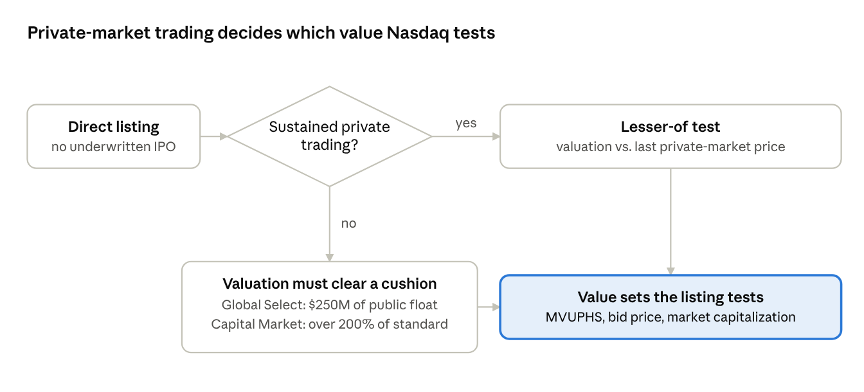
How Nasdaq tests value in a direct listing · 1 decision, 2 paths
Both paths end in one value that Nasdaq applies to every price-based listing test.
When a valuation report is required
An independent valuation is required in almost every Nasdaq direct listing of existing shares. Private-market trading does not remove the requirement; it only adds a second price that can cap the result.
Situation | Report required? | What the report has to do |
Direct listing, no sustained private-market trading (any tier) | Yes. It is the primary evidence. | Clear $250M of publicly held share value (Global Select) or more than 200% of the price, market value and MVUPHS requirements (Global Market, Capital Market). Nasdaq also uses it for the bid price and market cap tests. |
Direct listing with sustained trading in a Private Placement Market | Yes | Nasdaq uses the lower of the valuation and the latest private price, so the valuation must clear the thresholds on its own. |
Preferred stock converts, or the capital structure is reset, at listing | Yes, on the post-listing structure | Value common shares on the post-conversion share count expected at the opening. |
Material change before Nasdaq approves the listing (new financing round, tender offer, new quarterly financials, market dislocation) | Update or bring-down | The valuation must be recent as of approval and reflect the latest financials. Nasdaq can withdraw approval if it no longer reflects likely market value (IM-5315-1(e)). |
Nasdaq questions a gap to recent rounds, tenders or secondary prices | Supplemental analysis | Reconcile the conclusion to each transaction explicitly. |
Transfer from a foreign regulated exchange with a broad, liquid market | Generally no | Nasdaq measures value at the most recent foreign trading price. |
In practice, the company should engage the valuation agent when it begins preparing its listing application and registration statement. That leaves time to clear independence, receive Nasdaq’s comments and refresh the report before approval.
Requirements by tier
The Global Select Market sets a fixed dollar floor for the valuation. The Global Market and Capital Market instead require a multiple of whichever standard the company is listing under, and that multiple applies to the price test too. With a $4 minimum price on both lower tiers, the valuation has to support more than $8 per share.
Tier (rule) | Standard MVUPHS requirement | Valuation needed without private trading | Alternative evidence |
Global Select (IM-5315-1) | $110M, or $100M with stockholders’ equity of at least $110M | At least $250M of market value of publicly held shares, and the MVUPHS requirement must also be met. The valuation sets the bid price ($4) and market cap. | Lesser-of test when private trading exists |
Global Market (IM-5405-1) | $15M (Income Standard, up from $8M) to $20M, depending on the standard | More than 200% of the applicable requirement for price, market value of listed securities and MVUPHS. Under the $75M Market Value Standard, that means more than $150M of listed securities. | Nasdaq may accept other compelling evidence above 250%. Qualifying transactions must total at least 20% of the MVUPHS requirement, close within the prior six months and have no more than de minimis affiliate participation. |
Capital Market (IM-5505-1) | $15M under every standard (the Net Income Standard was raised from $5M) | More than 200% of the applicable requirement for price, market value of listed securities and MVUPHS | Same as the Global Market: other compelling evidence above 250%, with qualifying transactions totaling at least 20% of the MVUPHS requirement |
China-based companies may direct list only on the Global Select Market under SR-NASDAQ-2025-069, approved May 14, 2026.
The $15M Global Market and Capital Market figures took effect around January 2026 under SR-NASDAQ-2025-068. The Capital Market $4 price floor takes effect around October 30, 2026 under SR-NASDAQ-2026-082.
Independence of the valuation agent
Independence is the requirement that most often decides who can do the work. Nasdaq relies on the valuation because no underwriter has priced the shares, so it insists that the firm producing it has no stake in the listing going ahead.
Nasdaq accepts a valuation only from an agent with significant experience and demonstrated competence in valuing businesses. The agent also has to be independent of the issuer. An agent is not independent if it or any affiliate:
- Beneficially owns more than 5% of the class being listed, counting rights exercisable within 60 days;
- Provided investment banking services to the issuer in the 12 months before the valuation; or
- Has been engaged to provide investment banking services in connection with the listing, any related financing, or other related transactions.
Nasdaq defines “investment banking services” broadly. It includes acting as an underwriter, financial advisor, placement agent or member of a selling group. It also includes venture capital investments, equity lines of credit, PIPEs and similar investments.
Why the company’s bankers usually cannot serve. Most companies would turn first to the bank that knows them best. In a direct listing, that bank is almost always disqualified:
- A firm engaged to provide investment banking services in connection with the proposed listing, a related financing or other related transactions is excluded outright. That captures the company’s financial advisor on the listing.
- A firm that provided any investment banking services to the company in the 12 months before the valuation date is excluded. Nasdaq’s definition names underwriting, M&A advisory, placement agent and selling group roles, venture capital, equity lines and PIPEs, and is not limited to those. A bank that placed the last private round or advised on an acquisition within that window is out.
- A firm whose affiliates beneficially own more than 5% of the class being listed, counting rights exercisable within 60 days, is excluded. A venture investment by an affiliate within the 12-month window can disqualify the firm even below 5%, because providing venture capital is itself an investment banking service.
- Beyond the rule, a bank paid on the listing or hoping for follow-on mandates has an incentive that Nasdaq and investors may weigh, even when it technically qualifies.
The practical answer is a separate valuation firm with no investment banking relationship with the issuer, engaged early and confirmed independent before work begins.
Independence checklist before engagement.
- No investment banking services (including placement, M&A advisory or venture investment) for the issuer in the 12 months before the valuation date.
- No current or expected role on the listing, any related financing or related transactions.
- No beneficial ownership above 5% of the class by the firm or any affiliate, counting rights exercisable within 60 days.
- Firm-wide conflict check run across every affiliate, not just the valuation team.
- Independence representation documented in the engagement letter and available to Nasdaq.
Standards for the valuation itself (IM-5315-1(e)). The valuation has to be recent as of Nasdaq’s listing approval. It should take into account the company’s audited annual financial statements and any later quarterly statements. Nasdaq may withdraw its approval before the listing if the valuation no longer reflects the likely market value. The Global Market and Capital Market rules apply the same standards.
Implications for valuation firms that are also broker-dealers. A firm with an investment banking or capital-markets practice should check for conflicts across the whole firm before accepting the engagement. Earlier advisory or placement work for the issuer within 12 months can disqualify the firm. Prior fairness opinion work should be reviewed case by case, depending on whether it counts as financial advisory services. Serving as the company’s financial advisor on the listing is also disqualifying. The financial advisor that helps set the opening price and the independent valuation agent should be separate firms.
Valuation considerations
The listing valuation estimates what the shares will be worth once they trade publicly. That makes it a different exercise from a 409A or financial reporting valuation of illiquid private stock.
- Basis of value. The conclusion is a per-share value for freely tradable shares on a marketable minority basis. The tests measure public market value, so no discount for lack of marketability (DLOM) applies. Weight the guideline public company and market approaches heavily, and support the result with a DCF.
- MVUPHS, not equity value. Publicly held shares exclude shares held by officers, directors and holders of more than 10%. Restricted shares, including shares under lock-up, are also excluded. The value has to clear the threshold using the unrestricted float alone. In companies with concentrated founder or sponsor ownership, this can be a small fraction of fully diluted equity value.
- Capital structure. If preferred stock converts at listing, the per-share value should reflect the post-conversion common-only structure and the actual share count expected at the opening.
- Consistency with recent transactions. Nasdaq compares the valuation with recent preferred rounds, tender offers, secondary sales and private-market trades. Reconcile any gap explicitly. Where private trading exists, a high valuation does not help, because the lesser-of test applies.
- Currency. The valuation should be dated close to the listing and updated for any material change before the opening.
- Opening price is a separate step. Nasdaq sets the opening price in the opening cross under Rule 4753, working with the company’s financial advisor. The listing valuation shows the company qualifies; it does not set or guarantee the opening price.
Direct listing with a capital raise
A company can also sell new shares in its opening auction, but only on the Global Select Market (IM-5315-2). Unrestricted publicly held shares plus the new shares must total at least $110 million ($100 million with stockholders’ equity of at least $110 million). Nasdaq tests MVUPHS, bid price and market cap at a price 20% below the low end of the registration statement’s range. The auction mechanics, including the updated Rule 4120 halt framework (SR-NASDAQ-2026-064), sit with the company’s financial advisor and Nasdaq, not the valuation agent. For the valuation agent, the point is that the thresholds must hold at that discounted price, not just within the range.
Recent developments and open questions
Nasdaq has tightened its listing standards repeatedly since early 2025, and the October 2026 changes raise the bar again for valuation-based listings on the Capital Market.
Date | Filing | Change and relevance to direct listings |
Oct. 2026 (operative about Oct. 30) | Removes the $2–$3 Alternative Price Requirement on the Capital Market and sets a uniform $4 minimum. Under IM-5505-1’s 200% test, a valuation-based Capital Market listing now has to support more than $8 per share. | |
Oct. 2026 (expected Q2 2027) | Nasdaq Texas plans to become a primary listing venue. Its proposed direct listing rules mirror Nasdaq’s: an independent valuation, a 200% cushion without private trading, the lesser-of test, and no direct listings for China-based companies. | |
Sept. 2026 (pending) | Ties the new $5M market value of listed securities continued listing rule to the end of the SEC’s stay. This affects listed companies after the listing, not qualification. | |
Aug. 2026 | Puts the updated Rule 4120 halt and pricing framework into effect, including the financial advisor’s role in initial pricing and the DLCR mechanics. Conforming changes to IM-5315-2, IM-5405-1 and IM-5505-1. | |
May 14, 2026 | China-based companies may direct list only on the Global Select Market. Separately, IPOs need $25M of firm-commitment proceeds, and transfers need $25M of MVUPHS. | |
Dec. 19, 2025 | New IM-5101-3 lets Nasdaq deny a listing that meets every standard if the stock could be susceptible to manipulation. Float concentration and the advisors’ track records are listed factors. | |
Dec. 18, 2025 | Raises the minimum MVUPHS to $15M on the Capital Market Net Income Standard (from $5M) and the Global Market Income Standard (from $8M). The 200% valuation cushion therefore rises to more than $30M. | |
Mar. 2025 | Rule 5505(b) amendments | For a Capital Market IPO, the MVUPHS requirement must be met from offering proceeds. |
Open questions. The offering-proceeds language in Rule 5505(b) is tied to IPOs, and IM-5505-1 covers listings “without a related underwritten offering.” The rules still do not say whether, or how, the offering-proceeds language applies to a direct listing. IM-5101-3 also gives Nasdaq discretion that a valuation alone cannot overcome. A direct listing with a concentrated float could draw scrutiny even if it clears every numeric test.
- Confirm with Nasdaq Listing Qualifications how the offering-proceeds requirement applies to a valuation-based Capital Market direct listing.
- For a Capital Market or Global Market candidate, test whether the valuation supports more than $8 per share under the uniform $4 price floor.
- Ask Nasdaq early whether the expected float and holder concentration raise IM-5101-3 concerns.
Conclusion
In a direct listing, the valuation agent’s conclusion is often what determines whether the company qualifies. It has to clear a deliberately high bar ($250 million of publicly held share value on the Global Select Market, or more than 200% of the standard on the lower tiers), come from a firm with no investment banking ties to the issuer, and hold up against private-market prices and recent rounds. Because the company’s own bankers are usually disqualified, companies considering a direct listing should line up an independent valuation firm early, as soon as the listing application is in preparation. The firms best placed to deliver an opinion Nasdaq will accept are those that confirm independence firm-wide before engagement, value the float on a freely tradable basis and reconcile explicitly to recent transactions.
This paper summarizes listing rules for general information. It is not legal advice. Confirm current rule text with counsel and Nasdaq before relying on it in an engagement.
Sources